
 According to the new ENRE Resolution 85/2024, installations must be adapted to avoid fines and ensure that the Power Factor is optimized, avoiding surcharges and penalties of up to 20% on the electricity bill. This correction is achieved by installing capacitors that reduce reactive energy consumption, lowering current and losses.
What is Power Factor?
Es un indicador de la potencia eléctrica aprovechada o desperdiciada. Está dada por la relación trigonométrica entre la Potencia Activa (energía que se transforma en trabajo real, sea iluminación, movimiento, etc), la Potencia Reactiva (la energía desaprovechada en forma de efecto Joule – calor -, campos magnéticos, etc) y la Potencia Aparente, la cual es la energía que realmente está moviéndose por los conductores y la distribuidora entrega.
Un Factor de Potencia bajo significa:
- Mayor pérdida de energía.
- Menor eficiencia
- Mayor consumo de potencia reactiva
- Mayor dimensionamiento de la instalación. (conductores de mayor diámetro)
- Up to 20% fines on your electricity bill.
The closer the power factor is to 1, the greater the energy efficiency. This is achieved with capacitors.
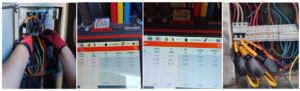
Los capacitores entregan Potencia Capacitiva que disminuye la Potencia Reactiva, bajando las pérdidas innecesarias. En motores se puede llegar a poner capacitores fijos que eleven el factor de potencia al estar la maquinaría en uso. En cambio, en instalaciones de consumos erráticos, se debe instalar un Banco Automático de Capacitores.
Power factor correction through the installation of capacitors improves the sustainability of companies' electrical installations, reducing their carbon footprint. To what extent? The most common power factors range between 0.75 and 0.90. If these values were increased to 0.95, for example, the reduction in electricity consumption would be between 10 and 20%, and therefore the same percentage reduction in the Carbon Footprint, especially in Scope 2.. ( Scope 2 emissions include Greenhouse Gas (GHG) emissions from purchased or acquired energy, such as electricity, steam, heat, or cooling.
 English
  Español de Argentina
  Português do Brasil